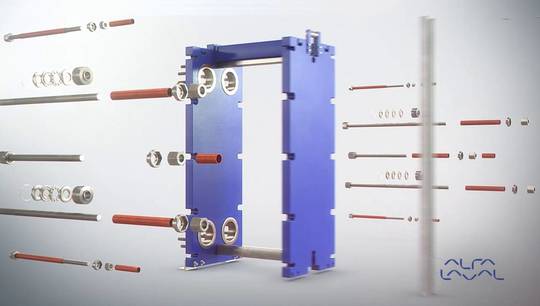
Reconditioning
Reducing life cycle costs of gasketed plate heat exchangers
You recondition a heat exchanger for one of two reasons:
One - it has lost performance, and the other one is because
the gaskets between the plates are approaching end of life.
My name is Magnus Edmen and I am head of service
for gasketed plate heat exchangers at Alfa Laval.
Our skilled professionals use state of the art equipment, state of
the art service procedures and the highest quality spare parts.
That is important, because that gives you performance
as good as new, reliability as good as new,
but also an opportunity to learn about emerging
problems and what to do about them.
The first thing we do when we receive the
heat exchanger, is arrival and inspection.
Here we are looking for any present or emerging
problems with the heat exchanger.
We remove the gaskets by submerging
the plates in a liquid nitrogen bath.
This is a very gentle and efficient way of removing
all the gaskets and the glue residues.
You want to do that, because if you don’t get all of that away,
you might face problems sealing the unit later on.
We clean the plates by submerging them in a caustic and acid bath.
It is important to get the right chemicals, concentration, temperature
and duration in order to have an efficient cleaning process.
If you get that right, you get plates in as good as new condition,
and if you don’t get it right, you risk damaging the plates.
We do post-cleaning inspection to identify any
signs of cracks, corrosion and deformation.
That is important because that helps you to improve the
reliability of the equipment when it is back in operation.
We do a non-destructive crack test to
identify cracks not even visible to the eye.
It is important to identify those, so you don’t have
any failures when you put the unit back in operation.
We use a two-component cured glue that gives
a very strong bond between the gasket and the plate.
That gives you the advantage, when you
do service in between reconditioning,
that the gaskets don’t fall out, and that
your cleaning processes will be more efficient.
To ensure the right shape of the gasket,
the right hardness, the right compound
and the right dimensional tolerances,
we only use genuine Alfa Laval gaskets.
That helps you to avoid premature leakage,
or even worse, damaging the plates.
We prefer to receive the entire unit
when you service your equipment with us.
By doing so, when can inspect the pressure
retaining parts and advice on replacement needs.
We can restore the corrosion protection
and we can also make sure that all
the plates are installed in the right order to
get you the right performance when the unit is back.
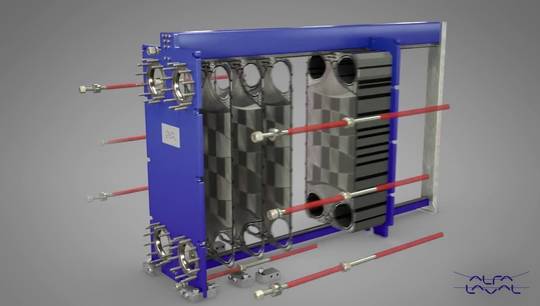
By servicing the frame with us, you are also ensured
to get the unit tightened to the right specification.
Not overtightened, not under tightened,
but to the right specification.
That avoids damaging the plates.
At the end, we also do a hydrostatic test. That is to
detect any internal or external leakages after assembly.
In our service report you will be able to see
exactly what we have done to the unit,
the problems we have identified and also
advice on future maintenance needs.
When reconditioning your equipment, it is important to work
with a partner who has very good product knowledge
and that uses state of the art technology, service procedures
and the right spare parts for your equipment.
Not getting all of this right, means a risk
of more than doubling the cost
of maintenance during the lifecycle of the product,
and that without even considering the
costs of downtime or lost production.
It is a great piece of equipment – let’s make sure it stays that way.