Hi,
my name is Cosimo Pecchioli and I'm with Alfa Laval data center cooling solutions.
And today we talk about whether it is advisable to decouple your cooling system if you have
an evaporative cooling tower or if you have air coolers.
The concept is that if you have an evaporative cooling tower,
of course, you have an open system that is exposed to the elements and all the contaminants in the air.
And so in that case,
actually, it's not really a choice.
It's
absolutely advisable
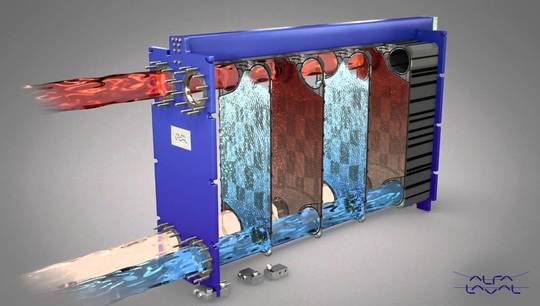
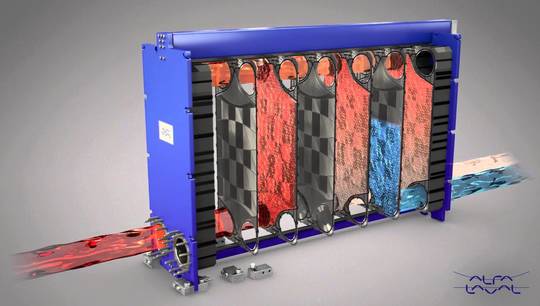
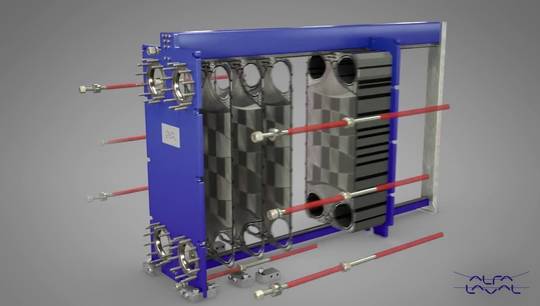
to put a heat exchanger in between your,
let's say, external ward
and your server room that acts like a shield and protects
your IT equipment.
And so, we're going to talk about the pros and cons that have been discussed at length through our meetings with the OCP,
the Open Compute Project.
And
so let's have a look at these list of advantages and disadvantages.
The advantages is that you can have different temperatures between the two loops,
that you can have one dirty side,
as we said, if it's an open cooling tower,
that side it's inherently dirtier than the other one.
You can have different pressures and you can have a differential pressure between the two sides.
Of course,
you have a fluid separation,
as we said, which is not only a quality issue,
but you can have different fluids.
One side, you might have glycol,
for instance, and the other side,
you might want water,
which of course has a higher heat transfer ratio,
or you can have like a refrigerant,
or you can have any kind of liquid cooling fluid.
And then you have a volume isolation.
Which is equally important if you have a large facility, you have a
large amount of water system moving around with very large pipes,
and you might not want to have these very large pipes inside of your server room for the safety consideration, of course.
Think about if you are in a seismic area
and you have a tremor,
all those joints might leak at a certain point.
And if you have a 24-inch pipe inside of your server room,
it's a situation maybe you don't want to experience.
And then if you are in co-location,
of course, the heat exchanger is a clear service level of agreement boundary.
So it's when the responsibility of one side ends and the responsibility of the other side actually begins.
So these are kind of the list of the advantages in decoupling
your cooling system.
But now let's have a look at the
cons,
at the disadvantages
of decoupling your system.
Of course, it's a
more complex situation.
So if you have two loops,
it's going to be a little more expensive.
And then of course, you add complexity,
which
inevitably translates into more maintenance.
Then there's space requirements,
of course.
If you want to add any sort of decoupling
facility of loop isolation,
you need actually the room or the space to make that happen.
And then as we mentioned before,
every time that you add complexity, you add maintenance.
I hope you found this very short video interesting.
And if you did,
you can take advantage of all the other videos where we go into the details.
Thank you very much and have a great day.